plot of chunk unnamed-chunk-14
We will be working with two data structures in R: vector and list.
We have seen how to create R vectors using the combine function
c.
num_vec = c(1, 2, 3) ## a vector of numbers
char_vec = c("I", "love", "econ") ## a vector of strings
In R, the vector is designed as a simple data structure:
All members of a vector must be of the same type (such as
char, numeric, or
boolean).
All vectors are flat. You cannot have a nested vector.
diff_types_vec = c(1, "a", TRUE)
diff_types_vec
#> [1] "1"    "a"    "TRUE"
R is very tolerant: instead of throwing an error, R silently
converts both 1 (a numeric variable) and TRUE
(a boolean variable) to characters.
diff_types_vec = c(1, TRUE)
diff_types_vec
#> [1] 1 1
In this case, R silently converts TRUE (a boolean
variable) to 1 (a numeric variable).
nested_vec = c(1, c(10, 15), c(1,3, c(2,6)))
nested_vec
#> [1]  1 10 15  1  3  2  6
All vectors are flat. c(1,c(3,4)) is the same as
c(1, 3, 4).
If you need an object containing variables of different types, use lists.
my_list = list(1, "a", TRUE)
my_list
#> [[1]]
#> [1] 1
#>
#> [[2]]
#> [1] "a"
#>
#> [[3]]
#> [1] TRUE
There are two ways to extract elements from a list:
my_list[[1]]: this returns a number
1
my_list[1]: this returns a list
list(1)
Lists can be nested:
nested_list = list(1, "a", list(TRUE, 2))
nested_list
#> [[1]]
#> [1] 1
#>
#> [[2]]
#> [1] "a"
#>
#> [[3]]
#> [[3]][[1]]
#> [1] TRUE
#>
#> [[3]][[2]]
#> [1] 2When we are doing statistical computations, in most cases we only deal with numeric numbers. Use vectors.
Lists are more sophisticated than vectors. We use lists only when we want to store various kinds of information in a single object.
For example, in our example of linear regression last time, the
object my_lm is indeed a list:
my_lm = lm(y ~ x, data = my_data)
Sometimes lists can be too powerful for our needs. It’s common that we work with an Excel table of the following form:
id   name age gender
1   Alice  20      F
2     Bob  23      M
3   Cindy  29      F
Specifically, we have four vectors/variables in the above table:
id, name, age,
gender. R provides a special data structure for this kind
of table-like object: dataframe.
Dataframe is a special kind of list. Like
list, it can contain values of different kinds.
We use data.frame() to create a dataframe:
df = data.frame(
  name = c("Alice", "Bob", "Cindy"),
  age = c(20, 23, 29),
  gender = c("F", "M", "F")
)
df
#>    name age gender
#> 1 Alice  20      F
#> 2   Bob  23      M
#> 3 Cindy  29      F
To extract the name information in df, use
df$name which works the same as
df[["name"]]:
df$name
#> [1] "Alice" "Bob" "Cindy"This example of linear regression is based on Intro to Statistical Learning (ISLR) ch3.6. It involves the Boston dataset, which pertains to Housing Values in Suburbs of Boston.
The Boston data set is found in the
MASS package.
library(MASS)After loading MASS, the onject Boston
is in your R workspace. Specifically, Boston is an object
in R of type list (or dataframe here).
typeof(Boston)
#> [1] "list"dim(Boston)
#> [1] 506 14To get some feeling about the Boston dataset:
run names(Boston), head(Boston),
str(Boston), or summary(Boston)
run ?Boston to see detailed documentation of the
Boston dataset in MASS
?Bostoncrim
per capita crime rate by town.
zn
proportion of residential land zoned for lots over 25,000 sq.ft.
indus
proportion of non-retail business acres per town.
chas
Charles River dummy variable (= 1 if tract bounds river; 0 otherwise).
nox
nitrogen oxides concentration (parts per 10 million).
rm
average number of rooms per dwelling.
age
proportion of owner-occupied units built prior to 1940.
dis
weighted mean of distances to five Boston employment centres.
rad
index of accessibility to radial highways.
tax
full-value property-tax rate per $10,000.
ptratio
pupil-teacher ratio by town.
black
1000*(Bk - 0.63)^2, where Bk is the proportion of blacks by town.
lstat
lower status of the population (percent).
medv
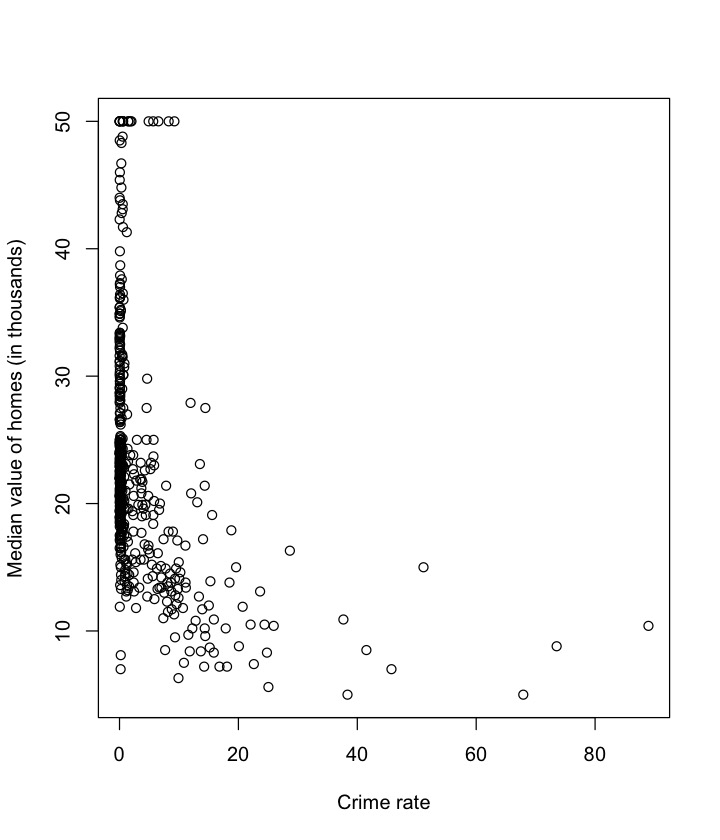
median value of owner-occupied homes in $1000s.Another (much better) way to explore a dataset is to use plots.
plot(Boston$crim, Boston$medv,
      xlab="Crime rate",
      ylab="Median value of homes (in thousands)")
plot of chunk unnamed-chunk-14
Based on the plot, it seems we should focus on those observations
with crim < 25 in plotting.
library(dplyr)
data_subset = tibble(crim=Boston$crim, medv=Boston$medv)
data_subset = filter(data_subset, crim<25)
Here I use the dplyr package which provides some useful
“verbs” (functions) for data manipulation. If you use the pipe operator
|>, an equivalent (but more readable) way is:
df = as_tibble(Boston) |>
  select(crim, medv) |>
filter(crim<25)plot(df$crim, df$medv,
xlab="Crime rate (less than 25)",
ylab="Median value of homes (in thousands)")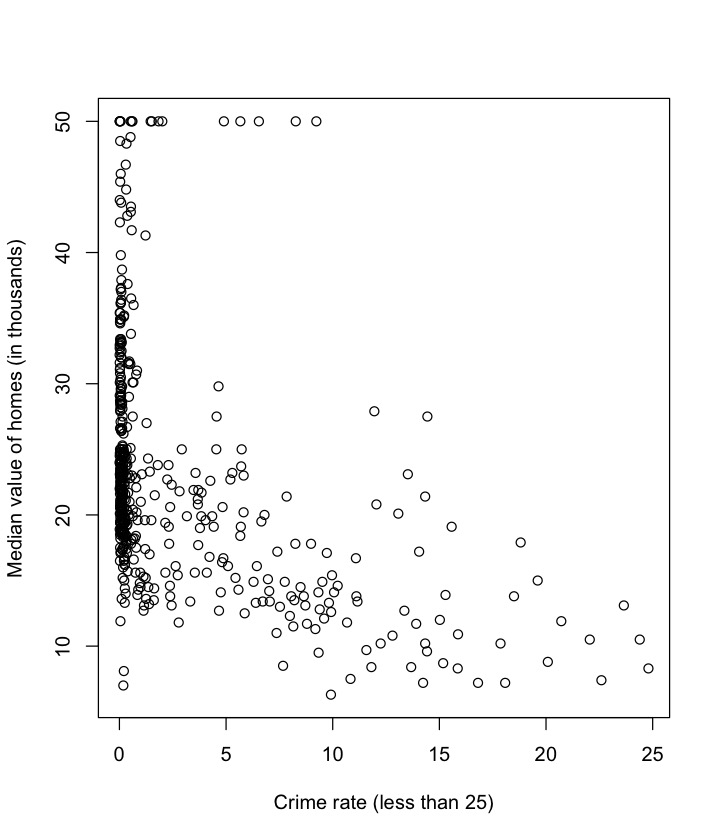
plot of chunk unnamed-chunk-17
Plot each feature against medv:
library(reshape2)
library(ggplot2)
bosmelt <- melt(Boston, id="medv")
ggplot(bosmelt, aes(x=value, y=medv))+
  facet_wrap(~variable, scales="free")+
  geom_point()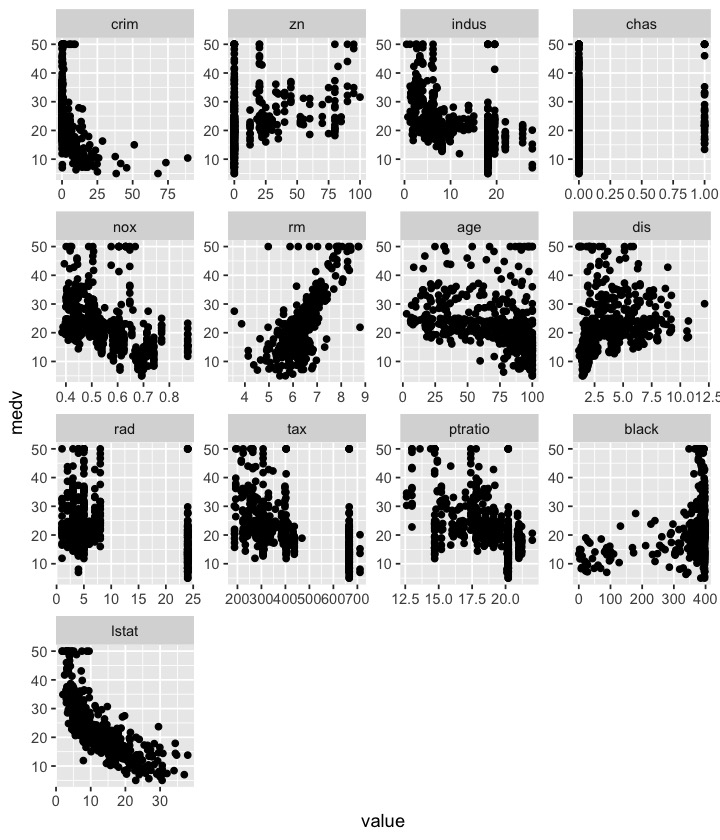
plot of chunk unnamed-chunk-18
Lastly, we compute and visualize the correlation matrix:
corr_m = cor(Boston)
round(corr_m, 2)
#>          crim    zn indus  chas   nox    rm   age   dis   rad   tax ptratio
#> crim     1.00 -0.20  0.41 -0.06  0.42 -0.22  0.35 -0.38  0.63  0.58    0.29
#> zn      -0.20  1.00 -0.53 -0.04 -0.52  0.31 -0.57  0.66 -0.31 -0.31   -0.39
#> indus    0.41 -0.53  1.00  0.06  0.76 -0.39  0.64 -0.71  0.60  0.72    0.38
#> chas    -0.06 -0.04  0.06  1.00  0.09  0.09  0.09 -0.10 -0.01 -0.04   -0.12
#> nox      0.42 -0.52  0.76  0.09  1.00 -0.30  0.73 -0.77  0.61  0.67    0.19
#> rm      -0.22  0.31 -0.39  0.09 -0.30  1.00 -0.24  0.21 -0.21 -0.29   -0.36
#> age      0.35 -0.57  0.64  0.09  0.73 -0.24  1.00 -0.75  0.46  0.51    0.26
#> dis     -0.38  0.66 -0.71 -0.10 -0.77  0.21 -0.75  1.00 -0.49 -0.53   -0.23
#> rad      0.63 -0.31  0.60 -0.01  0.61 -0.21  0.46 -0.49  1.00  0.91    0.46
#> tax      0.58 -0.31  0.72 -0.04  0.67 -0.29  0.51 -0.53  0.91  1.00    0.46
#> ptratio  0.29 -0.39  0.38 -0.12  0.19 -0.36  0.26 -0.23  0.46  0.46    1.00
#> black   -0.39  0.18 -0.36  0.05 -0.38  0.13 -0.27  0.29 -0.44 -0.44   -0.18
#> lstat    0.46 -0.41  0.60 -0.05  0.59 -0.61  0.60 -0.50  0.49  0.54    0.37
#> medv    -0.39  0.36 -0.48  0.18 -0.43  0.70 -0.38  0.25 -0.38 -0.47   -0.51
#>         black lstat  medv
#> crim    -0.39  0.46 -0.39
#> zn       0.18 -0.41  0.36
#> indus   -0.36  0.60 -0.48
#> chas     0.05 -0.05  0.18
#> nox     -0.38  0.59 -0.43
#> rm       0.13 -0.61  0.70
#> age     -0.27  0.60 -0.38
#> dis      0.29 -0.50  0.25
#> rad     -0.44  0.49 -0.38
#> tax     -0.44  0.54 -0.47
#> ptratio -0.18  0.37 -0.51
#> black    1.00 -0.37  0.33
#> lstat   -0.37  1.00 -0.74
#> medv 0.33 -0.74 1.00library(corrplot) ## visualizing the corr matrix
corrplot(corr_m)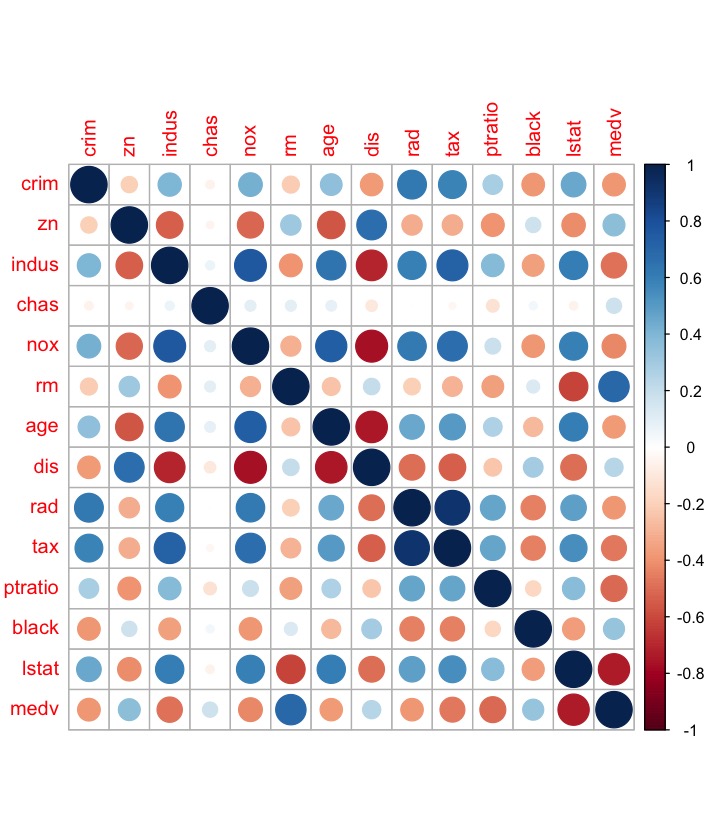
plot of chunk unnamed-chunk-20
We use the lm() function for running linear regression.
For example, the syntax lm(y ~ x1 + x2 + x3, data) fits a
model with three predictors:
.
Here the Boston dataset contains 13 variables. You can
manually specify all the 13 regressors. Fortunately, R provides the
short-hand . for performing a regression using all of the
predictors:
fit_all = lm(medv ~ ., data = Boston)As discussed above, fit_all is a list containing all
the regression info. The
summary(fit_all)
#>
#> Call:
#> lm(formula = medv ~ ., data = Boston)
#>
#> Residuals:
#>     Min      1Q  Median      3Q     Max
#> -15.595  -2.730  -0.518   1.777  26.199
#>
#> Coefficients:
#>               Estimate Std. Error t value Pr(>|t|)
#> (Intercept)  3.646e+01  5.103e+00   7.144 3.28e-12 ***
#> crim        -1.080e-01  3.286e-02  -3.287 0.001087 **
#> zn           4.642e-02  1.373e-02   3.382 0.000778 ***
#> indus        2.056e-02  6.150e-02   0.334 0.738288
#> chas         2.687e+00  8.616e-01   3.118 0.001925 **
#> nox         -1.777e+01  3.820e+00  -4.651 4.25e-06 ***
#> rm           3.810e+00  4.179e-01   9.116  < 2e-16 ***
#> age          6.922e-04  1.321e-02   0.052 0.958229
#> dis         -1.476e+00  1.995e-01  -7.398 6.01e-13 ***
#> rad          3.060e-01  6.635e-02   4.613 5.07e-06 ***
#> tax         -1.233e-02  3.760e-03  -3.280 0.001112 **
#> ptratio     -9.527e-01  1.308e-01  -7.283 1.31e-12 ***
#> black        9.312e-03  2.686e-03   3.467 0.000573 ***
#> lstat       -5.248e-01  5.072e-02 -10.347  < 2e-16 ***
#> ---
#> Signif. codes:  0 '***' 0.001 '**' 0.01 '*' 0.05 '.' 0.1 ' ' 1
#>
#> Residual standard error: 4.745 on 492 degrees of freedom
#> Multiple R-squared:  0.7406, Adjusted R-squared:  0.7338
#> F-statistic: 108.1 on 13 and 492 DF,  p-value: < 2.2e-16
Here the summary output still contains lots of info. We
can use summary(fit)$r.sq to see the
.
summary(fit_all)$r.sq ## short for summary(fit_all)[["r.sq"]]
#> [1] 0.7406427From the summary, age and indus seem to
have high p-values.
We can run a regression excluding these two predictors:
fit_ex = lm(medv ~ . - age - indus, data=Boston)summary(fit_ex)
#>
#> Call:
#> lm(formula = medv ~ . - age - indus, data = Boston)
#>
#> Residuals:
#> Min 1Q Median 3Q Max
#> -15.5984 -2.7386 -0.5046 1.7273 26.2373
#>
#> Coefficients:
#> Estimate Std. Error t value Pr(>|t|)
#> (Intercept) 36.341145 5.067492 7.171 2.73e-12 ***
#> crim -0.108413 0.032779 -3.307 0.001010 **
#> zn 0.045845 0.013523 3.390 0.000754 ***
#> chas 2.718716 0.854240 3.183 0.001551 **
#> nox -17.376023 3.535243 -4.915 1.21e-06 ***
#> rm 3.801579 0.406316 9.356 < 2e-16 ***
#> dis -1.492711 0.185731 -8.037 6.84e-15 ***
#> rad 0.299608 0.063402 4.726 3.00e-06 ***
#> tax -0.011778 0.003372 -3.493 0.000521 ***
#> ptratio -0.946525 0.129066 -7.334 9.24e-13 ***
#> black 0.009291 0.002674 3.475 0.000557 ***
#> lstat -0.522553 0.047424 -11.019 < 2e-16 ***
#> ---
#> Signif. codes: 0 '***' 0.001 '**' 0.01 '*' 0.05 '.' 0.1 ' ' 1
#>
#> Residual standard error: 4.736 on 494 degrees of freedom
#> Multiple R-squared: 0.7406, Adjusted R-squared: 0.7348
#> F-statistic: 128.2 on 11 and 494 DF, p-value: < 2.2e-16The syntax lstat:black tells R to include the
interaction term
.
The syntax lstat*age simultaneously include
lstat, age, and the interaction term
lstat:black as predictors:
summary(lm(medv ~ lstat*age, data=Boston))
#>
#> Call:
#> lm(formula = medv ~ lstat * age, data = Boston)
#>
#> Residuals:
#>     Min      1Q  Median      3Q     Max
#> -15.806  -4.045  -1.333   2.085  27.552
#>
#> Coefficients:
#>               Estimate Std. Error t value Pr(>|t|)
#> (Intercept) 36.0885359  1.4698355  24.553  < 2e-16 ***
#> lstat       -1.3921168  0.1674555  -8.313 8.78e-16 ***
#> age         -0.0007209  0.0198792  -0.036   0.9711
#> lstat:age    0.0041560  0.0018518   2.244   0.0252 *
#> ---
#> Signif. codes:  0 '***' 0.001 '**' 0.01 '*' 0.05 '.' 0.1 ' ' 1
#>
#> Residual standard error: 6.149 on 502 degrees of freedom
#> Multiple R-squared:  0.5557, Adjusted R-squared:  0.5531
#> F-statistic: 209.3 on 3 and 502 DF,  p-value: < 2.2e-16
To include the quadratic term X^2, use
I(X^2):
The special function I() is needed since the hat
symbol ^ has a special meaning in a formula.
fit_nonlinear = lm(medv~lstat+I(lstat^2), data = Boston)
summary(fit_nonlinear)
#>
#> Call:
#> lm(formula = medv ~ lstat + I(lstat^2), data = Boston)
#>
#> Residuals:
#>      Min       1Q   Median       3Q      Max
#> -15.2834  -3.8313  -0.5295   2.3095  25.4148
#>
#> Coefficients:
#>              Estimate Std. Error t value Pr(>|t|)
#> (Intercept) 42.862007   0.872084   49.15   <2e-16 ***
#> lstat       -2.332821   0.123803  -18.84   <2e-16 ***
#> I(lstat^2)   0.043547   0.003745   11.63   <2e-16 ***
#> ---
#> Signif. codes:  0 '***' 0.001 '**' 0.01 '*' 0.05 '.' 0.1 ' ' 1
#>
#> Residual standard error: 5.524 on 503 degrees of freedom
#> Multiple R-squared:  0.6407, Adjusted R-squared:  0.6393
#> F-statistic: 448.5 on 2 and 503 DF,  p-value: < 2.2e-16
The near-zero p-value associated with the quadratic term suggests that it leads to an improved model.
What’s the difference between vector and list? Explain in your own words.
m = matrix(1:4, nrow = 2). Is m a
vector or a list?
Is the dataset Boston a vector or a list?
Read about the dataset (?Boston) and answer the
following questions.
How to know the number of rows and columns in dataset
Boston?
Make some pairwise scatterplots of the predictors (columns) in this data set. Describe your findings.
Are any of the predictors associated with crim (per
capita crime rate)? If so, explain the relationship.
Do any of the suburbs of Boston appear to have particularly high crime rates? Tax rates? Pupil-teacher ratios? Comment on the range of each predictor.
How many of the suburbs in this data set bound the Charles river?
Colophon. This document is built with Pandoc and Knitr, with the following knitr setup:
knitr::opts_chunk$set(collapse = TRUE, comment = "#>")